 Kalhara JA
← All Blogs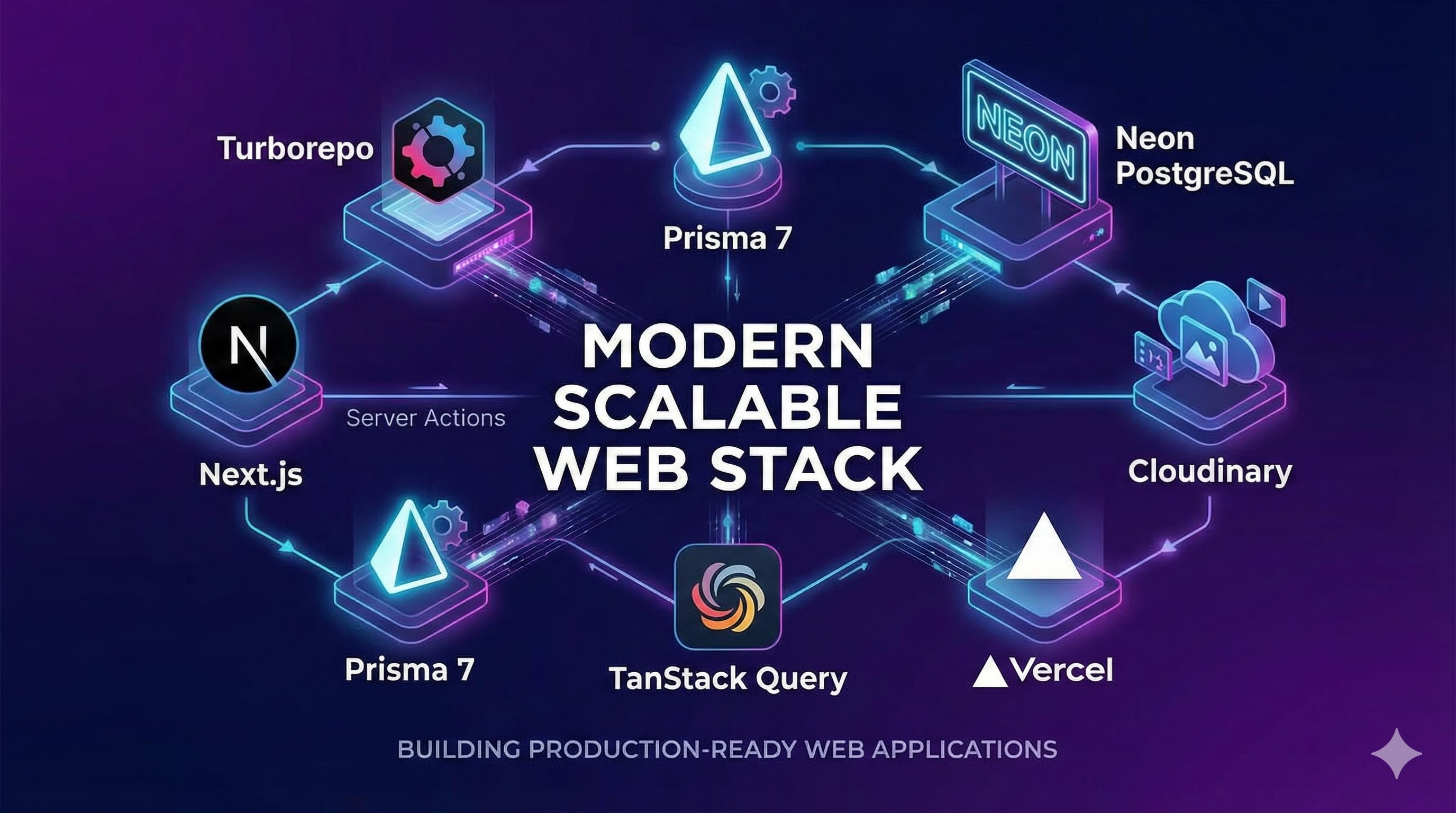
July 12, 2026 · 4 min read · Kalhara JA
My Modern Scalable Web App Stack for 2026
My Advanced Tech Stack for Building Modern, Scalable Web Applications
Modern web development moves fast and building scalable applications requires tools that work together smoothly. After working with many frameworks, databases, deployment platforms, and architectural patterns, I have refined a stack that has become my primary choice for real world production projects. It focuses on performance, developer experience, and predictable architecture.
This article covers each part of that stack with practical explanations and implementation details. It includes Turborepo, Next.js with Server Actions, Prisma 7, Neon PostgreSQL, TanStack Query, Cloudinary, Better Auth or NextAuth, and deployment to Vercel with standalone output.
1. Monorepo Architecture with Turborepo
Turborepo provides a scalable foundation by grouping all related projects and shared packages inside one monorepo.
Recommended layout
apps/
  web/                 Next.js application
packages/
  ui/                  Shared UI components
  db/                  Prisma schema and client
  utils/               Shared utilities
Why this matters
- Faster builds through incremental and remote caching
- Shared packages reduce duplicated logic
- Simplifies dependency management for multi app systems
2. Next.js App Router with Server Actions
Next.js is the core of this stack. The App Router adds structured layouts, while Server Actions remove the need for separate API layers in most cases.
Benefits
- SSR, SSG, ISR, and RSC built in
- Server Actions allow secure server side mutations with no client API code
- Reduced bundle sizes because logic stays on the server
- Cleaner UI structure through nested layouts
Example Server Action
"use server";

import { prisma } from "@/packages/db/prisma";

export async function createTask(data: { title: string }) {
  return prisma.task.create({ data });
}
3. TypeScript Across the Entire Stack
TypeScript eliminates many classes of runtime bugs and makes refactoring safer. Prisma generates typed models and TanStack Query infers types, creating a fully typed chain from database to UI.
4. Database Layer with Prisma 7 and Neon PostgreSQL
Prisma 7 introduced major improvements that make it ideal for cloud native environments.
What changed in Prisma 7
- Rust engine removed. The client is now entirely JavaScript based.
- Up to three times faster queries in official benchmarks.
- Up to ninety percent smaller bundles.
- Reduced generated types for better TypeScript performance.
- ESM first design for modern bundlers and runtimes.
Why Neon PostgreSQL
- Serverless friendly with low cold start time
- Branchable databases for previews and testing
- Works well with Prisma’s new JS based engine
Example Prisma schema
generator client {
  provider = "prisma-client-js"
}

datasource db {
  provider = "postgresql"
  url      = env("DATABASE_URL")
}

model Task {
  id        String   @id @default(cuid())
  title     String
  createdAt DateTime @default(now())
}
Safe Prisma client singleton
import { PrismaClient } from "@prisma/client";

declare global {
  var __prisma: PrismaClient | undefined;
}

export const prisma =
  global.__prisma ??
  new PrismaClient({
    log: ["query", "warn", "error"]
  });

if (process.env.NODE_ENV !== "production") {
  global.__prisma = prisma;
}
5. Authentication with NextAuth or Better Auth
Both NextAuth and Better Auth integrate naturally with the Next.js App Router.
Why they work well
- Seamless handling of sessions and providers
- Works with Server Components
- Supports OAuth and custom strategies
Minimal NextAuth example
import NextAuth from "next-auth";
import GitHub from "next-auth/providers/github";

export const handler = NextAuth({
  providers: [GitHub],
  session: { strategy: "jwt" }
});

export { handler as GET, handler as POST };
6. TanStack Query for Server State Management
TanStack Query handles caching and server state synchronization. It replaces unnecessary global state for data that comes from APIs or the database.
Fetch example
const query = useQuery({
  queryKey: ["tasks"],
  queryFn: async () => {
    const res = await fetch("/api/tasks");
    return res.json();
  }
});
Mutation example
const mutation = useMutation({
  mutationFn: createTask,
  onSuccess: () => queryClient.invalidateQueries(["tasks"])
});
7. Cloudinary for Media Storage and Processing
Cloudinary is used for all media because it supports on the fly transformations, responsive formats, and global CDN delivery.
Example upload route
import { v2 as cloudinary } from "cloudinary";

cloudinary.config({
  cloud_name: process.env.CLOUDINARY_CLOUD,
  api_key: process.env.CLOUDINARY_KEY,
  api_secret: process.env.CLOUDINARY_SECRET
});

export async function POST(req: Request) {
  const { file } = await req.json();
  const upload = await cloudinary.uploader.upload(file, {
    folder: "myapp"
  });
  return Response.json(upload);
}
8. Deployment with Vercel using Standalone Output
Vercel is the ideal deployment environment for this stack.
Why
- Native support for Server Actions
- Efficient caching
- Built in edge functions and image optimization
- Remote caching that works with Turborepo
Standalone output configuration
/** @type {import('next').NextConfig} */
module.exports = {
  output: "standalone",
  images: {
    domains: ["res.cloudinary.com"]
  }
};
Final Thoughts
This stack forms a complete, production ready foundation for modern web applications.
Summary of the system
- Turborepo for monorepo structure
- Next.js App Router with Server Actions
- TypeScript from backend to frontend
- Prisma 7 with Neon PostgreSQL
- NextAuth or Better Auth for authentication
- TanStack Query for server driven state
- Cloudinary for media storage
- Vercel for deployment using standalone output
Each tool solves a specific problem without adding unnecessary complexity. Together they create a fast, predictable, and maintainable development workflow.